Monodomain convergence test#
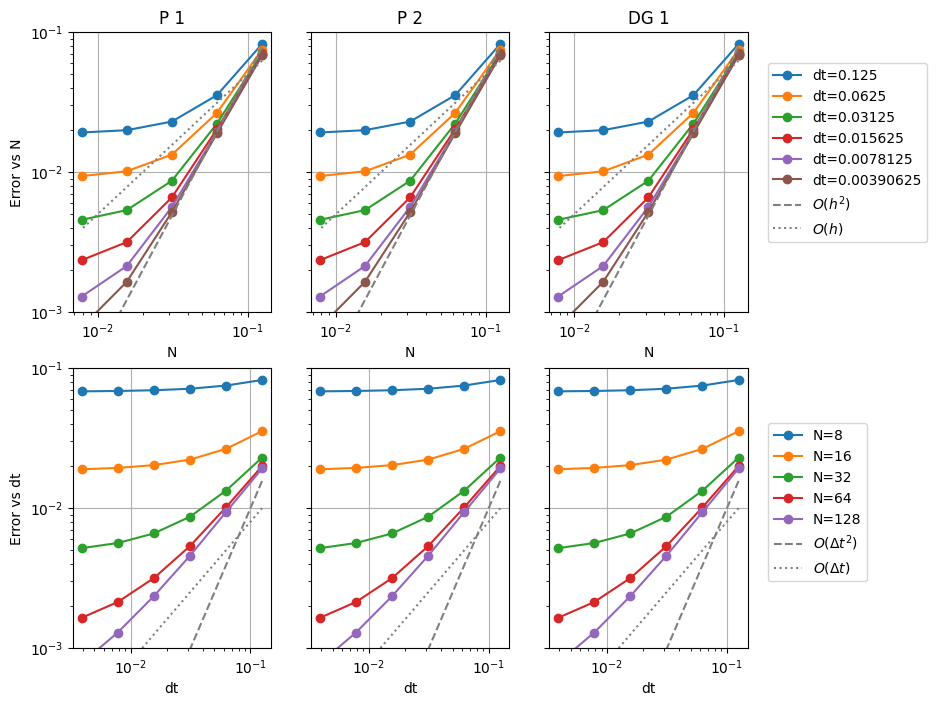
In this example, we will demonstrate how to perform a convergence test for the monodomain model using the forward Euler method for the ODE solver. We will use the same test case as in the tests/test_monodomain.py file. We will compare the error in the solution for different spatial and temporal resolutions. We will use the L2 norm of the error as the error measure.
We use the method of manufactured solutions: rather than starting from a cell model, we pick a
transmembrane potential \(v\) and a gating variable \(s\) ourselves (v_exact_func and s_exact_func
below), and derive the stimulus current \(I_{stim}\) (ac_func) that makes the monodomain equation
(with \(C_m = 1\) and constant \(M\)) exactly satisfied by our chosen \(v\) and \(s\). Since we then know the
exact solution, we can measure the \(L^2\) error of the numerical solution produced by
beat.MonodomainSplittingSolver for decreasing mesh size \(h = 1/N\) and time step \(\Delta t\), and
check that it decreases at the expected rate — second order in space (from the finite element
discretization) and first order in time for Godunov splitting (\(\theta = 1\), the solver’s default).
See the verification demo for the corresponding second-order-in-time check using
Strang splitting, and the mathematical background page for where the
operator splitting scheme comes from.
def simple_ode_forward_euler(states, t, dt, parameters):
    v, s = states
    values = np.zeros_like(states)
    values[0] = v - s * dt
    values[1] = s + v * dt
    return values
def main():
    M = 1.0
    T = 1.0
    t0 = 0.0

    comm = MPI.COMM_WORLD
    odespaces = ["P_1", "P_2", "DG_1"]
    Ns = [2**level for level in range(3, 8)]
    dts = [2 ** (-i) for i in range(3, 9)]
    fig, ax = plt.subplots(
        2,
        len(odespaces),
        figsize=(10, 8),
        sharey="row",
        sharex="row",
    )
    for k, odespace in enumerate(odespaces):
        errors = defaultdict(list)
        error_fname = Path(f"convergence_{odespace}.json")
        if not error_fname.is_file():
            for dt in dts:
                print(f"Running for dt={dt}")
                for N in Ns:
                    print(f"Running for N={N}")
                    mesh = dolfinx.mesh.create_unit_square(
                        comm,
                        N,
                        N,
                        dolfinx.mesh.CellType.triangle,
                    )
                    time = dolfinx.fem.Constant(mesh, dolfinx.default_scalar_type(0.0))
                    x = ufl.SpatialCoordinate(mesh)

                    I_s = ac_func(x, time)

                    pde = beat.MonodomainModel(time=time, mesh=mesh, M=M, I_s=I_s)

                    V_ode = beat.utils.space_from_string(odespace, mesh, dim=1)
                    v_ode = dolfinx.fem.Function(V_ode)

                    s = dolfinx.fem.Function(V_ode)
                    s.interpolate(
                        dolfinx.fem.Expression(
                            s_exact_func(x, time),
                            beat.utils.interpolation_points(V_ode),
                        ),
                    )

                    s_arr = s.x.array
                    init_states = np.zeros((2, s_arr.size))
                    init_states[1, :] = s_arr

                    ode = beat.odesolver.DolfinODESolver(
                        v_ode=v_ode,
                        v_pde=pde.state,
                        fun=simple_ode_forward_euler,
                        init_states=init_states,
                        parameters=None,
                        num_states=2,
                        v_index=0,
                    )
                    solver = beat.MonodomainSplittingSolver(pde=pde, ode=ode, theta=1.0)
                    solver.solve((t0, T), dt=dt)

                    v_exact = v_exact_func(x, T)
                    error = dolfinx.fem.form((pde.state - v_exact) ** 2 * ufl.dx)
                    E = np.sqrt(
                        comm.allreduce(dolfinx.fem.assemble_scalar(error), MPI.SUM),
                    )
                    errors[str(dt)].append(E)
            error_fname.write_text(json.dumps(errors))
        errors = json.loads(error_fname.read_text())
        errors_N = {}

        for i, N in enumerate(Ns):
            errors_N[N] = [errors[str(dt)][i] for dt in dts]
        lines_dt = []
        labels_dt = []
        for dt, errs in errors.items():
            (l,) = ax[0, k].loglog([1 / N for N in Ns], errs, "-o")
            lines_dt.append(l)
            labels_dt.append(f"dt={dt}")
        (l,) = ax[0, k].loglog(
            [1 / N for N in Ns],
            [5 / N**2 for N in Ns],
            "--",
            color="gray",
        )
        lines_dt.append(l)
        labels_dt.append("$O(h^2)$")
        (l,) = ax[0, k].loglog(
            [1 / N for N in Ns],
            [0.5 / N for N in Ns],
            ":",
            color="gray",
        )
        lines_dt.append(l)
        labels_dt.append("$O(h)$")

        ax[0, k].set_xlabel("N")
        lines_N = []
        labels_N = []
        for N, errs in errors_N.items():
            (l,) = ax[1, k].loglog(dts, errs, "-o")
            lines_N.append(l)
            labels_N.append(f"N={N}")
        (l,) = ax[1, k].loglog(
            dts,
            [dt**2 for dt in dts],
            "--",
            color="gray",
        )
        lines_N.append(l)
        labels_N.append(r"$O(\Delta t^2)$")
        (l,) = ax[1, k].loglog(
            dts,
            [0.08 * dt for dt in dts],
            ":",
            color="gray",
        )
        lines_N.append(l)
        labels_N.append(r"$O(\Delta t)$")

        ax[1, k].set_xlabel("dt")
        ax[0, k].set_title(" ".join(odespace.split("_")))
        if k == 0:
            ax[0, k].set_ylabel("Error vs N")
            ax[1, k].set_ylabel("Error vs dt")

    for axi in ax.flatten():
        axi.grid()
        axi.set_ylim([1e-3, 0.1])

    fig.subplots_adjust(right=0.8)
    fig.legend(
        lines_dt,
        labels_dt,
        loc="upper center",
        bbox_to_anchor=(0.9, 0.85),
    )
    fig.legend(
        lines_N,
        labels_N,
        loc="upper center",
        bbox_to_anchor=(0.87, 0.4),
    )

    fig.savefig("convergence.png")
    # rates = [np.log(e1 / e2) / np.log(2) for e1, e2 in zip(errors[:-1], errors[1:])]
    # cvg_rate = sum(rates) / len(rates)
    # print(rates)
    # breakpoint()
    # assert np.isclose(cvg_rate, 2, rtol=0.15)
if __name__ == "__main__":
    main()
Running for dt=0.125
Running for N=8
Running for N=16
Running for N=32
Running for N=64
Running for N=128
Running for dt=0.0625
Running for N=8
Running for N=16
Running for N=32
Running for N=64
Running for N=128
Running for dt=0.03125
Running for N=8
Running for N=16
Running for N=32
Running for N=64
Running for N=128
Running for dt=0.015625
Running for N=8
Running for N=16
Running for N=32
Running for N=64
Running for N=128
Running for dt=0.0078125
Running for N=8
Running for N=16
Running for N=32
Running for N=64
Running for N=128
Running for dt=0.00390625
Running for N=8
Running for N=16
Running for N=32
Running for N=64
Running for N=128
Running for dt=0.125
Running for N=8
Running for N=16
Running for N=32
Running for N=64
Running for N=128
Running for dt=0.0625
Running for N=8
Running for N=16
Running for N=32
Running for N=64
Running for N=128
Running for dt=0.03125
Running for N=8
Running for N=16
Running for N=32
Running for N=64
Running for N=128
Running for dt=0.015625
Running for N=8
Running for N=16
Running for N=32
Running for N=64
Running for N=128
Running for dt=0.0078125
Running for N=8
Running for N=16
Running for N=32
Running for N=64
Running for N=128
Running for dt=0.00390625
Running for N=8
Running for N=16
Running for N=32
Running for N=64
Running for N=128
Running for dt=0.125
Running for N=8
Running for N=16
Running for N=32
Running for N=64
Running for N=128
Running for dt=0.0625
Running for N=8
Running for N=16
Running for N=32
Running for N=64
Running for N=128
Running for dt=0.03125
Running for N=8
Running for N=16
Running for N=32
Running for N=64
Running for N=128
Running for dt=0.015625
Running for N=8
Running for N=16
Running for N=32
Running for N=64
Running for N=128
Running for dt=0.0078125
Running for N=8
Running for N=16
Running for N=32
Running for N=64
Running for N=128
Running for dt=0.00390625
Running for N=8
Running for N=16
Running for N=32
Running for N=64
Running for N=128