
Problem 3 on an axisymmetric geometry#
This example solves Problem 3 of the cardiac mechanics benchmark [LGA+15] (see Problem 3) the way one of its participants did: on the meridian of the ventricle, with curved (isoparametric) elements. That entry, by Simone Pezzuto, was written in legacy FEniCS and is available at https://bitbucket.org/peppu/mechbench.
The truncated ellipsoid is a solid of revolution, and so is the loading. The fiber field is not symmetric under a reflection through a meridian plane, so the ventricle twists, but nothing depends on the angle about the axis. The problem can then be solved on one meridian, a 2D domain with coordinates \((Z, R)\), for a displacement with three components: the axial and radial displacement \(u_Z\) and \(u_R\), and the twist \(\phi\), the angle a point turns by about the axis.
The deformation is \(z = Z + u_Z\), \(r = R + u_R\), \(\theta = \Theta + \phi\) and its gradient, in the orthonormal bases of cylindrical coordinates, is
A point of the meridian stands for the circle it sweeps, so every integral is weighted by
\(2 \pi R\). pulse.AxisymmetricHeartGeometry does both, and the rest of the problem
is set up as in 3D.
import math
import typing
from pathlib import Path
import dolfinx
import numpy as np
import cardiac_geometries
import pulse
1. Geometry and fibers#
cardiac_geometries.mesh.lv_ellipsoid_2D makes the meridian of the ellipsoid of Problems 2
and 3, with the long axis along \(x\) and the radial direction along \(y\). The apex is at
\(x = -17\) mm (endocardium) and \(x = -20\) mm (epicardium), and the base at \(x = 5\) mm. The
segment of the axis between the two apices is marked APEX: the points there must stay on
the axis, which pulse.AxisymmetricHeartGeometry imposes with \(u_R = 0\). The
cardiac-geometriesx demo of this geometry
shows the mesh, the markers, the transmural coordinate and the fibers.
As in Pezzuto’s entry, the elements are of order 2, so the endocardium and the epicardium are
curved, and the size of the elements is 3 mm at the base and 1.5 mm at the apex, divided by
ndiv.
The fibers have three components, in the axial, radial and circumferential direction. The fiber angle goes from \(+90^\circ\) at the endocardium to \(-90^\circ\) at the epicardium, linearly in the transmural coordinate \(t\) the benchmark defines through the ellipsoid itself: a point is on the ellipsoid with radii \(r_s(t) = 7 + 3t\) and \(r_l(t) = 17 + 3t\). They are evaluated at the quadrature points.
quadrature_degree = 6
def create_geometry(ndiv: int) -> tuple[pulse.AxisymmetricHeartGeometry, typing.Any]:
    geodir = Path(f"lv_ellipsoid_2D-problem3-ndiv{ndiv}")
    if not geodir.exists():
        comm.barrier()
        cardiac_geometries.mesh.lv_ellipsoid_2D(
            outdir=geodir,
            r_short_endo=7.0,
            r_short_epi=10.0,
            r_long_endo=17.0,
            r_long_epi=20.0,
            mu_apex_endo=math.pi,
            mu_base_endo=math.acos(5 / 17),
            mu_apex_epi=math.pi,
            mu_base_epi=math.acos(5 / 20),
            psize_ref=3.0 / ndiv,
            create_fibers=True,
            fiber_angle_endo=90,
            fiber_angle_epi=-90,
            fiber_space=f"Quadrature_{quadrature_degree}",
            order=2,
            comm=comm,
        )
    geo = cardiac_geometries.geometry.Geometry.from_folder(comm=comm, folder=geodir)
    geometry = pulse.AxisymmetricHeartGeometry.from_cardiac_geometries(
        geo,
        metadata={"quadrature_degree": quadrature_degree},
        axis_marker="APEX",
    )
    return geometry, geo
2. Model, boundary conditions and solution#
The model is the one of Problem 3: transversely isotropic Guccione material (\(C = 2\) kPa, \(b_f = 8\), \(b_t = 2\), \(b_{fs} = 4\)), incompressible, with an active stress \(T_a\) along the fibers. The base is fixed, in all three components, and the pressure acts on the endocardium. The pressure goes to 15 kPa and \(T_a\) to 60 kPa, together.
def solve(ndiv: int) -> dict[str, float]:
    geometry, geo = create_geometry(ndiv)

    def constant(value: float) -> dolfinx.fem.Constant:
        return dolfinx.fem.Constant(geometry.mesh, dolfinx.default_scalar_type(value))

    material = pulse.Guccione(
        f0=geo.f0,
        s0=geo.s0,
        n0=geo.n0,
        C=constant(2.0),
        bf=constant(8.0),
        bt=constant(2.0),
        bfs=constant(4.0),
    )
    Ta = constant(0.0)
    model = pulse.CardiacModel(
        material=material,
        active=pulse.ActiveStress(geo.f0, activation=pulse.Variable(Ta, "kPa")),
        compressibility=pulse.Incompressible(),
    )

    pressure = constant(0.0)
    neumann = pulse.NeumannBC(
        traction=pulse.Variable(pressure, "kPa"),
        marker=geo.markers["ENDO"][0],
    )
    problem = pulse.StaticProblem(
        model=model,
        geometry=geometry,
        bcs=pulse.BoundaryConditions(neumann=(neumann,)),
        parameters={"base_bc": pulse.BaseBC.fixed},
    )

    steps = 20
    for p, ta in zip(np.linspace(0, 15.0, steps + 1)[1:], np.linspace(0, 60.0, steps + 1)[1:]):
        pressure.value = p
        Ta.value = ta
        if not problem.solve():
            raise RuntimeError(f"Newton did not converge at p = {p:.2f} kPa, Ta = {ta:.2f} kPa")

    # The position of the apices along the axis
    X = dolfinx.fem.Function(problem.u.function_space)
    X.interpolate(lambda x: (x[0], x[1], np.zeros_like(x[0])))
    result = {"ndiv": ndiv}
    for name, marker in [("endo", "ENDOPT"), ("epi", "EPIPT")]:
        tag = geo.markers[marker][0]
        x = pulse.utils.evaluate_at_vertex_tag(X, geo.vfun, tag)
        u = pulse.utils.evaluate_at_vertex_tag(problem.u, geo.vfun, tag)
        result[name] = pulse.utils.gather_broadcast_array(comm, x + u)[0, 0]
    result["volume"] = comm.allreduce(geometry.volume("ENDO", problem.u), op=MPI.SUM)
    result["dofs"] = sum(
        V.dofmap.index_map.size_global * V.dofmap.index_map_bs
        for V in (problem.u_space, problem.p_space)
    )
    result["u"] = problem.u
    return result
results = [solve(ndiv) for ndiv in (1, 2, 4)]
3.0
Info    : Meshing 1D...
Info    : [  0%] Meshing curve 1 (Line)
Info    : [ 30%] Meshing curve 2 (Line)
Info    : [ 60%] Meshing curve 3 (Ellipse)
Info    : [ 80%] Meshing curve 4 (Ellipse)
Info    : Done meshing 1D (Wall 0.00484029s, CPU 0.004014s)
Info    : Meshing 2D...
Info    : Meshing surface 1 (Plane, Frontal-Delaunay)
Info    : Done meshing 2D (Wall 0.000719759s, CPU 0.000783s)
Info    : 39 nodes 79 elements
Info    : Meshing order 2 (curvilinear on)...
Info    : [  0%] Meshing curve 1 order 2
Info    : [ 30%] Meshing curve 2 order 2
Info    : [ 50%] Meshing curve 3 order 2
Info    : [ 70%] Meshing curve 4 order 2
Info    : [ 90%] Meshing surface 1 order 2
Info    : Surface mesh: worst distortion = 0.801745 (0 elements in ]0, 0.2]); worst gamma = 0.849482
Info    : Done meshing order 2 (Wall 0.000577823s, CPU 0.000613s)
Info    : Optimizing mesh (HighOrder)...
Info    : Optimizing high-order mesh...
Info    : Optimizing mesh...
Info    : Computing connectivity and bad elements for entity 1...
Info    : Starting patch generation from 0 bad elements...
Info    : Constructing 0 primary patches
Info    : Computing patch connectivity...
Info    : Identifying groups of primary patches...
Info    : Merging primary patches into 0 patches...
Info    : Computing boundaries for 0 patches...
Info    : Generated 0 patches
Info    : Optimization succeeded
Info    : Done optimizing mesh (0.000192 s)
Info    : Done optimizing high-order mesh (0.000192 s)
Info    : Done optimizing mesh (Wall 0.000162815s, CPU 0.000286s)
Info    : Writing 'lv_ellipsoid_2D-problem3-ndiv1/lv_ellipsoid_2D.msh'...
Info    : Done writing 'lv_ellipsoid_2D-problem3-ndiv1/lv_ellipsoid_2D.msh'
2026-10-30 15:53:21 [debug    ] Convert file lv_ellipsoid_2D-problem3-ndiv1/lv_ellipsoid_2D.msh to dolfin
Setting C to c_0 kPa
Info    : Reading 'lv_ellipsoid_2D-problem3-ndiv1/lv_ellipsoid_2D.msh'...
Info    : 10 entities
Info    : 122 nodes
Info    : 78 elements
Info    : Done reading 'lv_ellipsoid_2D-problem3-ndiv1/lv_ellipsoid_2D.msh'
1.5
Info    : Meshing 1D...
Info    : [  0%] Meshing curve 1 (Line)
Info    : [ 30%] Meshing curve 2 (Line)
Info    : [ 60%] Meshing curve 3 (Ellipse)
Info    : [ 80%] Meshing curve 4 (Ellipse)
Info    : Done meshing 1D (Wall 0.0047262s, CPU 0.004869s)
Info    : Meshing 2D...
Info    : Meshing surface 1 (Plane, Frontal-Delaunay)
Info    : Done meshing 2D (Wall 0.00213572s, CPU 0.002187s)
Info    : 112 nodes 225 elements
Info    : Meshing order 2 (curvilinear on)...
Info    : [  0%] Meshing curve 1 order 2
Info    : [ 30%] Meshing curve 2 order 2
Info    : [ 50%] Meshing curve 3 order 2
Info    : [ 70%] Meshing curve 4 order 2
Info    : [ 90%] Meshing surface 1 order 2
Info    : Surface mesh: worst distortion = 0.880685 (0 elements in ]0, 0.2]); worst gamma = 0.854415
Info    : Done meshing order 2 (Wall 0.00131749s, CPU 0.001446s)
Info    : Optimizing mesh (HighOrder)...
Info    : Optimizing high-order mesh...
Info    : Optimizing mesh...
Info    : Computing connectivity and bad elements for entity 1...
Info    : Starting patch generation from 0 bad elements...
Info    : Constructing 0 primary patches
Info    : Computing patch connectivity...
Info    : Identifying groups of primary patches...
Info    : Merging primary patches into 0 patches...
Info    : Computing boundaries for 0 patches...
Info    : Generated 0 patches
Info    : Optimization succeeded
Info    : Done optimizing mesh (0.00034 s)
Info    : Done optimizing high-order mesh (0.00034 s)
Info    : Done optimizing mesh (Wall 0.000344556s, CPU 0.000455s)
Info    : Writing 'lv_ellipsoid_2D-problem3-ndiv2/lv_ellipsoid_2D.msh'...
Info    : Done writing 'lv_ellipsoid_2D-problem3-ndiv2/lv_ellipsoid_2D.msh'
2026-10-30 15:53:29 [debug    ] Convert file lv_ellipsoid_2D-problem3-ndiv2/lv_ellipsoid_2D.msh to dolfin
Setting C to c_8 kPa
Info    : Reading 'lv_ellipsoid_2D-problem3-ndiv2/lv_ellipsoid_2D.msh'...
Info    : 10 entities
Info    : 387 nodes
Info    : 224 elements
Info    : Done reading 'lv_ellipsoid_2D-problem3-ndiv2/lv_ellipsoid_2D.msh'
0.75
Info    : Meshing 1D...
Info    : [  0%] Meshing curve 1 (Line)
Info    : [ 30%] Meshing curve 2 (Line)
Info    : [ 60%] Meshing curve 3 (Ellipse)
Info    : [ 80%] Meshing curve 4 (Ellipse)
Info    : Done meshing 1D (Wall 0.00525078s, CPU 0.005419s)
Info    : Meshing 2D...
Info    : Meshing surface 1 (Plane, Frontal-Delaunay)
Info    : Done meshing 2D (Wall 0.00677736s, CPU 0.006836s)
Info    : 377 nodes 755 elements
Info    : Meshing order 2 (curvilinear on)...
Info    : [  0%] Meshing curve 1 order 2
Info    : [ 30%] Meshing curve 2 order 2
Info    : [ 50%] Meshing curve 3 order 2
Info    : [ 70%] Meshing curve 4 order 2
Info    : [ 90%] Meshing surface 1 order 2
Info    : Surface mesh: worst distortion = 0.935682 (0 elements in ]0, 0.2]); worst gamma = 0.752929
Info    : Done meshing order 2 (Wall 0.00273427s, CPU 0.002909s)
Info    : Optimizing mesh (HighOrder)...
Info    : Optimizing high-order mesh...
Info    : Optimizing mesh...
Info    : Computing connectivity and bad elements for entity 1...
Info    : Starting patch generation from 0 bad elements...
Info    : Constructing 0 primary patches
Info    : Computing patch connectivity...
Info    : Identifying groups of primary patches...
Info    : Merging primary patches into 0 patches...
Info    : Computing boundaries for 0 patches...
Info    : Generated 0 patches
Info    : Optimization succeeded
Info    : Done optimizing mesh (0.000634 s)
Info    : Done optimizing high-order mesh (0.000634 s)
Info    : Done optimizing mesh (Wall 0.000784141s, CPU 0.000825s)
Info    : Writing 'lv_ellipsoid_2D-problem3-ndiv4/lv_ellipsoid_2D.msh'...
Info    : Done writing 'lv_ellipsoid_2D-problem3-ndiv4/lv_ellipsoid_2D.msh'
2026-10-30 15:53:31 [debug    ] Convert file lv_ellipsoid_2D-problem3-ndiv4/lv_ellipsoid_2D.msh to dolfin
Setting C to c_16 kPa
Info    : Reading 'lv_ellipsoid_2D-problem3-ndiv4/lv_ellipsoid_2D.msh'...
Info    : 10 entities
Info    : 1393 nodes
Info    : 754 elements
Info    : Done reading 'lv_ellipsoid_2D-problem3-ndiv4/lv_ellipsoid_2D.msh'
3. Results#
Pezzuto’s axisymmetric results with elements of order 2 were, for the same ndiv
(positions of the apices in mm, cavity volume in mm\(^3\)):
ndiv |
dofs |
volume |
epicardial apex |
endocardial apex |
|---|---|---|---|---|
1 |
404 |
1794.49 |
-15.427 |
-11.932 |
2 |
1272 |
1798.55 |
-15.463 |
-12.285 |
4 |
4906 |
1796.17 |
-15.466 |
-12.342 |
64 |
1116576 |
1795.89 |
-15.452 |
-12.347 |
where ndiv = 64 is the finest mesh he solved on. The meshes are not the same, as gmsh
meshes the meridian anew, so the numbers do not have to agree at a given ndiv, but they
should converge to the same values.
if comm.rank == 0:
    print(f"{'ndiv':>4} {'dofs':>8} {'volume':>10} {'epi':>9} {'endo':>9}")
    for r in results:
        print(
            f"{r['ndiv']:>4d} {r['dofs']:>8d} {r['volume']:>10.2f} "
            f"{r['epi']:>9.3f} {r['endo']:>9.3f}",
        )
ndiv     dofs     volume       epi      endo
   1      404    1803.93   -15.481   -11.951
   2     1272    1796.44   -15.470   -12.292
   4     4555    1796.12   -15.468   -12.346
4. Visualization#
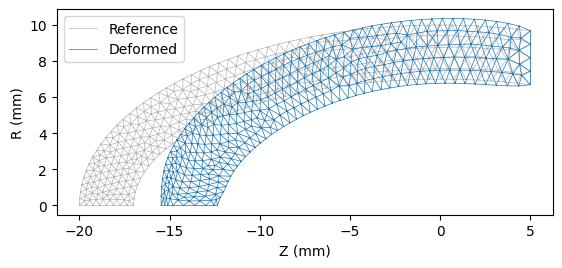
The meridian before and after, on the finest mesh.
try:
    import matplotlib.pyplot as plt
except ImportError:
    print("matplotlib is not installed")
else:
    u = results[-1]["u"]
    mesh = u.function_space.mesh
    V1 = dolfinx.fem.functionspace(mesh, ("Lagrange", 1, (3,)))
    u1 = dolfinx.fem.Function(V1)
    u1.interpolate(u)
    # The triangles and coordinates of the dofs of V1, in the order of u1's values
    topology, _, x = dolfinx.plot.vtk_mesh(V1)
    cells = topology.reshape(-1, 4)[:, 1:]
    X, R = x[:, 0], x[:, 1]
    U = u1.x.array.reshape(-1, 3)

    fig, ax = plt.subplots()
    ax.triplot(X, R, cells, color="0.7", linewidth=0.5, label="Reference")
    ax.triplot(X + U[:, 0], R + U[:, 1], cells, color="C0", linewidth=0.5, label="Deformed")
    ax.set_xlabel("Z (mm)")
    ax.set_ylabel("R (mm)")
    ax.set_aspect("equal")
    ax.legend()
    fig.savefig("problem3_axisymmetric.png", dpi=200)
References#
Sander Land, Viatcheslav Gurev, Sander Arens, Christoph M Augustin, Lukas Baron, Robert Blake, Chris Bradley, Sebastian Castro, Andrew Crozier, Marco Favino, and others. Verification of cardiac mechanics software: benchmark problems and solutions for testing active and passive material behaviour. Proceedings of the Royal Society A: Mathematical, Physical and Engineering Sciences, 471(2184):20150641, 2015. doi:10.1098/rspa.2015.0641.