
Pericardium: sliding springs versus normal springs#
The pericardium is a stiff sac around the heart, separated from it by a thin film of
fluid. It holds the epicardium in place in the normal direction but lets it slide along
the sac without friction [PHW+19]. A common model is a spring on
the epicardium, a pulse.RobinBC, with stiffnesses up to \(5 \cdot 10^7\) Pa/m
[SGA+20].
A RobinBC measures the gap to the pericardium by projecting the displacement onto a
normal, \(k (\mathbf{u} \cdot \mathbf{n}) \mathbf{n}\). On a curved surface, the
epicardium sliding along itself then counts as a normal gap. A rotation by
\(\theta\) about the long axis gives a gap of about \(r (1 - \cos \theta)\), so stiff springs
hold back the twist of the ventricle.
pulse.PericardiumBC measures the gap as the change in signed distance \(d\) to a surface
fixed in space, \(g = d(\mathbf{X} + \mathbf{u}) - d(\mathbf{X})\), and stores the energy
\(\frac{1}{2} \int k g^2 \, dA\). A point that slides along the surface keeps its
distance to it, and feels no force.
This demo contracts an LV ellipsoid held by either epicardial condition, at the same stiffness, and compares the twist, the motion of the base and apex, and the volumes. It ends with a movie of the two side by side. The pericardium is the epicardial ellipsoid, first as a formula and then, for comparison, as a surface made from the mesh.
import math
from pathlib import Path
import cardiac_geometries
import cardiac_geometries.geometry
import dolfinx
import numpy as np
import ufl
import pulse
Geometry#
An LV ellipsoid in metres, with its long axis along \(x\), the apex at \(x = -97\) mm and the base at \(x \approx 24\) mm.
outdir = Path("lv_ellipsoid_pericardium")
outdir.mkdir(parents=True, exist_ok=True)
geodir = outdir / "geometry"
comm = MPI.COMM_WORLD
if not (geodir / "mesh.xdmf").exists():
    cardiac_geometries.mesh.lv_ellipsoid(
        outdir=geodir,
        create_fibers=True,
        fiber_space="Quadrature_6",
        r_short_endo=0.025,
        r_short_epi=0.035,
        r_long_endo=0.09,
        r_long_epi=0.097,
        psize_ref=0.008,
        mu_apex_endo=-math.pi,
        mu_base_endo=-math.acos(5 / 17),
        mu_apex_epi=-math.pi,
        mu_base_epi=-math.acos(5 / 20),
        comm=comm,
        fiber_angle_epi=-60,
        fiber_angle_endo=60,
    )
2026-10-12 20:28:17 [debug ] Convert file lv_ellipsoid_pericardium/geometry/lv_ellipsoid.msh to dolfin
Info    : Reading 'lv_ellipsoid_pericardium/geometry/lv_ellipsoid.msh'...
Info    : 54 entities
Info    : 1669 nodes
Info    : 8739 elements
Info    : Done reading 'lv_ellipsoid_pericardium/geometry/lv_ellipsoid.msh'
geo = cardiac_geometries.geometry.Geometry.from_folder(comm=comm, folder=geodir)
geometry = pulse.HeartGeometry.from_cardiac_geometries(geo)
markers = {name: geometry.markers[name][0] for name in ("ENDO", "EPI", "BASE")}
The pericardium is the epicardial ellipsoid itself, read from the parameters the mesh
was made with. In general it can be any object with a signed_distance(x) method that
returns the signed distance to the surface (positive outside) as a UFL expression.
EllipsoidSurface(r_long=0.097, r_short=0.035, center=(0.0, 0.0, 0.0), axis=(1.0, 0.0, 0.0))
A geometry from an image has no such formula. For that, pulse.MeshSurface makes a
smooth surface through the facets with a given marker, as they are now; see
the next demo. We run it here too, to compare it with the
ellipsoid that these facets approximate.
mesh_surface = pulse.MeshSurface.from_geometry(geometry, "EPI")
print(mesh_surface)
MeshSurface(1394 facets and 112 beyond their edge, radius=0.0151)
Model#
A transversely isotropic Holzapfel-Ogden material, contracted by an active stress along the fibres.
def constant(value):
    return dolfinx.fem.Constant(geometry.mesh, dolfinx.default_scalar_type(value))
def create_model():
    material = pulse.HolzapfelOgden(
        f0=geo.f0,
        s0=geo.s0,
        **pulse.HolzapfelOgden.transversely_isotropic_parameters(),
    )
    Ta = pulse.Variable(constant(0.0), "kPa")
    model = pulse.CardiacModel(
        material=material,
        active=pulse.ActiveStress(geo.f0, activation=Ta),
        compressibility=pulse.Compressible(),
    )
    return model, Ta
Boundary conditions#
The base hangs on springs. They resist its in-plane motion firmly, and its motion along
the long axis only weakly, so that the base can descend towards the apex as the
ventricle contracts. On the epicardium we put either a RobinBC along the current
normal (pulse’s default for springs) or a PericardiumBC, with the ellipsoid or with
the surface from the mesh, all with \(k = 10^7\) Pa/m.
k_epi = 1e7 # Pa/m
def create_bcs(epicardium: str):
    pressure = pulse.Variable(constant(0.0), "kPa")
    neumann = [pulse.NeumannBC(traction=pressure, marker=markers["ENDO"])]
    robin = [
        pulse.RobinBC(value=pulse.Variable(constant(1e5), "Pa / m"), marker=markers["BASE"]),
        pulse.RobinBC(
            value=pulse.Variable(constant(1e6), "Pa / m"),
            marker=markers["BASE"],
            perpendicular=True,
        ),
    ]
    pericardium = []
    k = pulse.Variable(constant(k_epi), "Pa / m")
    if epicardium == "RobinBC":
        robin.append(pulse.RobinBC(value=k, marker=markers["EPI"]))
    elif epicardium == "PericardiumBC":
        pericardium.append(pulse.PericardiumBC(stiffness=k, marker=markers["EPI"], surface=surface))
    elif epicardium == "MeshSurface":
        pericardium.append(
            pulse.PericardiumBC(stiffness=k, marker=markers["EPI"], surface=mesh_surface),
        )
    else:
        raise ValueError(epicardium)
    bcs = pulse.BoundaryConditions(neumann=neumann, robin=robin, pericardium=pericardium)
    return bcs, pressure
Measurements#
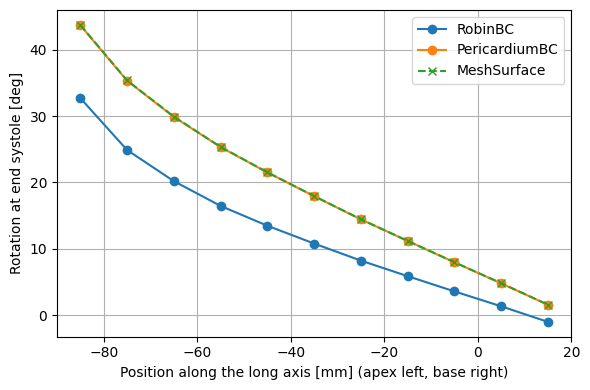
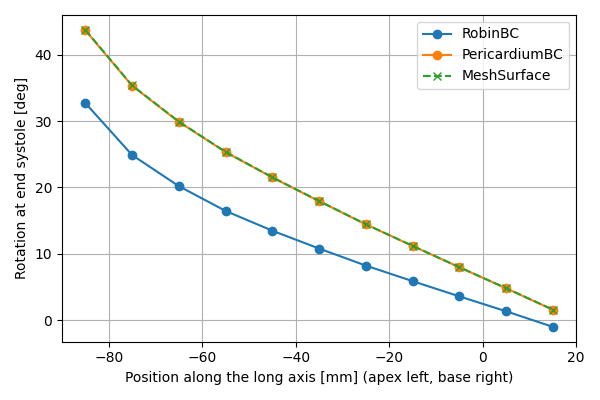
We measure the cavity volume, the mean displacement of the base and of the apex along the long axis, and the mean rotation about the long axis of the epicardium in slices along it. The twist is the rotation of an apical slice minus that of a basal one. The gap is how far the epicardium has moved away from (or into) the pericardium, as a root mean square of \(d(\mathbf{X} + \mathbf{u}) - d(\mathbf{X})\). The smallest Jacobian determinant \(J\) tells us whether any element is about to invert.
def measurements(problem):
    u = problem.u
    V = problem.u_space
    X = V.tabulate_dof_coordinates()
    U = u.x.array.reshape(-1, 3)
    n_owned = V.dofmap.index_map.size_local

    def dofs(marker):
        found = dolfinx.fem.locate_dofs_topological(V, 2, geometry.facet_tags.find(marker))
        return found[found < n_owned]

    epi, base = dofs(markers["EPI"]), dofs(markers["BASE"])

    def mean(values):
        total = comm.allreduce(np.sum(values, axis=0), op=MPI.SUM)
        return total / comm.allreduce(len(values), op=MPI.SUM)

    def rotation(lo, hi):
        sel = epi[(X[epi, 0] > lo) & (X[epi, 0] < hi)]
        r0 = X[sel, 1:]
        r1 = r0 + U[sel, 1:]
        angle = np.arctan2(r0[:, 0] * r1[:, 1] - r0[:, 1] * r1[:, 0], (r0 * r1).sum(axis=1))
        return float(np.degrees(mean(angle)))

    # The cavity is open at the base, so measure its volume from a point on the base
    x_base = geometry.base_center("BASE", u)
    F = ufl.Identity(3) + ufl.grad(u)
    x = geometry.X + u - ufl.as_vector(x_base)
    volume_form = (-1 / 3) * ufl.det(F) * ufl.dot(x, ufl.inv(F).T * geometry.facet_normal)
    volume = comm.allreduce(
        dolfinx.fem.assemble_scalar(dolfinx.fem.form(volume_form * geometry.ds(markers["ENDO"]))),
        op=MPI.SUM,
    )

    ds_epi = geometry.ds(markers["EPI"])
    gap = surface.signed_distance(geometry.X + u) - surface.signed_distance(geometry.X)
    gap2, area = (
        comm.allreduce(dolfinx.fem.assemble_scalar(dolfinx.fem.form(f * ds_epi)), op=MPI.SUM)
        for f in (gap**2, constant(1.0))
    )

    Q = dolfinx.fem.functionspace(geometry.mesh, ("DG", 0))
    J = dolfinx.fem.Function(Q)
    J.interpolate(dolfinx.fem.Expression(ufl.det(F), Q.element.interpolation_points))
    apex = epi[X[epi, 0] < -0.095]

    slices = np.linspace(-0.09, 0.02, 12)
    return {
        "volume [mL]": volume * 1e6,
        "base [mm]": 1e3 * mean(U[base, 0]),
        "apex [mm]": 1e3 * mean(U[apex, 0]),
        "basal rotation [deg]": rotation(0.0, 0.02),
        "apical rotation [deg]": rotation(-0.085, -0.065),
        "gap [mm]": 1e3 * math.sqrt(gap2 / area),
        "min J": comm.allreduce(J.x.array.min(), op=MPI.MIN),
        "profile": (
            slices[:-1] + np.diff(slices) / 2,
            [rotation(a, b) for a, b in zip(slices[:-1], slices[1:])],
        ),
    }
Simulation#
We inflate the ventricle to an end-diastolic pressure of 1.5 kPa, then raise the active
tension to 40 kPa at that pressure. solve returns False if Newton does not
converge, so we check every step. After every step we keep the displacement,
interpolated onto linear elements, for the movie at the end.
V1 = dolfinx.fem.functionspace(geometry.mesh, ("Lagrange", 1, (3,)))
frames: dict[str, list[tuple[str, np.ndarray]]] = {}
def run(epicardium: str):
    model, Ta = create_model()
    bcs, pressure = create_bcs(epicardium)
    problem = pulse.StaticProblem(
        model=model,
        geometry=geometry,
        bcs=bcs,
        parameters={"base_bc": pulse.BaseBC.free, "mesh_unit": "m"},
    )
    u1 = dolfinx.fem.Function(V1)
    frames[epicardium] = []

    def keep(p, ta):
        u1.interpolate(problem.u)
        label = f"p = {p:.1f} kPa, Ta = {ta:.0f} kPa"
        frames[epicardium].append((label, u1.x.array.reshape(-1, 3).copy()))

    keep(0.0, 0.0)
    for step, value in enumerate(np.linspace(0.0, 1.5, 7)[1:]):
        pressure.assign(value)
        if not problem.solve():
            raise RuntimeError(f"{epicardium}: Newton did not converge at {value} kPa")
        if step % 2 == 1:
            keep(value, 0.0)
    end_diastole = measurements(problem)

    for value in np.linspace(0.0, 40.0, 9)[1:]:
        Ta.assign(value)
        if not problem.solve():
            raise RuntimeError(f"{epicardium}: Newton did not converge at Ta = {value} kPa")
        keep(1.5, value)
    end_systole = measurements(problem)
    return end_diastole, end_systole
results = {name: run(name) for name in ("RobinBC", "PericardiumBC", "MeshSurface")}
Results#
if comm.rank == 0:
    rows = [
        ("EDV [mL]", lambda ed, es: ed["volume [mL]"]),
        ("ESV [mL]", lambda ed, es: es["volume [mL]"]),
        ("EF [%]", lambda ed, es: 100 * (1 - es["volume [mL]"] / ed["volume [mL]"])),
        ("base, systole [mm]", lambda ed, es: es["base [mm]"] - ed["base [mm]"]),
        ("apex, systole [mm]", lambda ed, es: es["apex [mm]"] - ed["apex [mm]"]),
        ("basal rotation [deg]", lambda ed, es: es["basal rotation [deg]"]),
        ("apical rotation [deg]", lambda ed, es: es["apical rotation [deg]"]),
        (
            "twist [deg]",
            lambda ed, es: es["apical rotation [deg]"] - es["basal rotation [deg]"],
        ),
        ("gap, systole [mm]", lambda ed, es: es["gap [mm]"]),
        ("min J", lambda ed, es: es["min J"]),
    ]
    print(f"{'':24}" + "".join(f"{name:>16}" for name in results))
    for label, f in rows:
        print(f"{label:24}" + "".join(f"{f(*results[name]):16.2f}" for name in results))
                                 RobinBC   PericardiumBC     MeshSurface
EDV [mL]                          188.60          184.61          184.43
ESV [mL]                          106.62          107.95          107.90
EF [%]                             43.47           41.53           41.49
base, systole [mm]                -15.07          -17.90          -17.67
apex, systole [mm]                  1.15           -1.08           -1.11
basal rotation [deg]                0.18            3.21            3.23
apical rotation [deg]              25.30           35.72           35.77
twist [deg]                        25.11           32.51           32.54
gap, systole [mm]                   1.21            0.45            0.47
min J                               0.92            0.92            0.92
The displacements of the base and the apex are along the long axis, from end diastole to
end systole; negative is towards the apex. Rotations are positive counterclockwise when
seen from the base. The last column is the PericardiumBC with the surface from the mesh;
its gap is measured to the ellipsoid, like the others.
try:
    import matplotlib.pyplot as plt
except ImportError:
    print("matplotlib is not installed")
else:
    if comm.rank == 0:
        fig, ax = plt.subplots(figsize=(6, 4))
        for name, (_, end_systole) in results.items():
            x, rotation = end_systole["profile"]
            style = {"linestyle": "--", "marker": "x"} if name == "MeshSurface" else {"marker": "o"}
            ax.plot(1e3 * x, rotation, label=name, **style)
        ax.set_xlabel("Position along the long axis [mm] (apex left, base right)")
        ax.set_ylabel("Rotation at end systole [deg]")
        ax.grid(True)
        ax.legend()
        fig.tight_layout()
        fig.savefig(outdir / "rotation.png")
Movie#
To see the difference, we render the first two runs side by side, from the side (top row) and from the apex (bottom row). The stripes follow the tissue. They run along the long axis in the reference configuration, and wind into helices as the ventricle twists. The grey shape is the reference configuration, and its outer surface is the pericardium.
def animate(path, names=("RobinBC", "PericardiumBC"), substeps=6, hold=10, fps=20):
    cells, cell_types, points = dolfinx.plot.vtk_mesh(V1)
    grid = pyvista.UnstructuredGrid(cells, cell_types, points)
    for name in names:
        for i, (_, u) in enumerate(frames[name]):
            grid[f"{name} {i}"] = u
    # Subdivide the surface for sharper stripes. The displacements are interpolated
    # linearly onto the new points, so the motion is still the computed one.
    surface = grid.extract_surface().subdivide(2, subfilter="linear")
    X = surface.points.copy()
    stripes = np.sin(6 * np.arctan2(X[:, 2], X[:, 1]))
    labels = [label for label, _ in frames[names[0]]]

    # From the side with the base up, and from the apex: (direction, up, zoom)
    views = [((0.0, 1.0, 0.3), (1.0, 0.0, 0.0), 1.1), ((-1.0, 0.0, 0.0), (0.0, 0.0, 1.0), 2.0)]
    plotter = pyvista.Plotter(
        shape=(len(views), len(names)),
        row_weights=[1.5, 1.0],
        window_size=(720, 688),
        border=False,
        off_screen=True,
    )
    plotter.set_background("white")
    meshes: dict[str, list[pyvista.PolyData]] = {name: [] for name in names}
    for row, (view, viewup, zoom) in enumerate(views):
        for col, name in enumerate(names):
            plotter.subplot(row, col)
            if row == 0:
                plotter.add_text(name, font_size=12, color="black", position="upper_edge")
            plotter.add_mesh(pyvista.PolyData(X, surface.faces), color="grey", opacity=0.15)
            mesh = pyvista.PolyData(X.copy(), surface.faces)
            mesh["stripes"] = stripes
            plotter.add_mesh(
                mesh,
                cmap=["#8b1a2b", "#f2c9cf"],
                show_scalar_bar=False,
                smooth_shading=True,
            )
            meshes[name].append(mesh)
            plotter.view_vector(view, viewup=viewup)
            plotter.camera.zoom(zoom)

    def draw(t):
        """The picture at load step `t`, interpolated linearly between the steps around it"""
        i = min(int(t), len(labels) - 2)
        for name, copies in meshes.items():
            u = (i + 1 - t) * surface[f"{name} {i}"] + (t - i) * surface[f"{name} {i + 1}"]
            for mesh in copies:
                mesh.points = X + u
        plotter.subplot(len(views) - 1, 0)
        plotter.add_text(
            labels[round(t)],
            font_size=9,
            color="black",
            position="lower_left",
            name="label",
        )
        return plotter.screenshot(return_img=True)

    # Forwards, then back so that the movie loops
    forwards = np.linspace(0, len(labels) - 1, substeps * (len(labels) - 1) + 1)
    times = np.concatenate([forwards, np.full(hold, forwards[-1]), forwards[::-1], np.zeros(hold)])
    with imageio.get_writer(path, fps=fps, macro_block_size=8, quality=6) as writer:
        for t in times:
            writer.append_data(draw(t))
    plotter.close()
try:
    import imageio.v2 as imageio
    import imageio_ffmpeg  # noqa: F401
    import pyvista
except ImportError:
    print("pyvista, imageio and imageio-ffmpeg are needed for the movie")
else:
    # In parallel each process has only its own part of the mesh. The page shows a copy
    # of this file, `_static/pericardium.mp4`.
    if comm.size == 1:
        animate(outdir / "pericardium.mp4")
/tmp/ipykernel_1006/2333159820.py:9: PyVistaFutureWarning: The default value of `algorithm` for the filter
`UnstructuredGrid.extract_surface` will change in the future. It currently defaults to
`'dataset_surface'`, but will change to `None`. Explicitly set the `algorithm` keyword to
silence this warning.
  surface = grid.extract_surface().subdivide(2, subfilter="linear")
With the PericardiumBC the stripes wind further and the base comes further down. With
the RobinBC the epicardium comes away from the grey shape towards the apex, where the
PericardiumBC keeps it on the pericardium.
Discussion#
Both conditions hold the apex in place and let the base descend towards it, as the
pericardium does in vivo, and they fill and eject about the same volumes. On this mesh
the RobinBC resists the rotation of the epicardium, so the ventricle twists less, and
yet it lets the epicardium move further from the pericardium. How much a RobinBC along
the current normal resists the twist depends on the mesh: on finer meshes it resists it
less, and lets the epicardium move further still. Along the reference normal it resists
the twist far more, on any mesh. The PericardiumBC lets the epicardium slide, keeps it
at its distance from the pericardium on any mesh, and lets the ventricle twist at least
as much as one without epicardial springs.
The surface made from the mesh gives the same as the ellipsoid: the twist differs by 0.03 degrees, the volumes by 0.2 mL and the descent of the base by 0.2 mm. The surface only approximates the ellipsoid, and its integral is a sum over the nodes of the epicardium rather than over the quadrature points; both contribute.
Both conditions keep the epicardium near where it is in the reference configuration. Here that is the unloaded ventricle, so stiff springs also resist filling. Softer springs (\(k \lesssim 10^6\) Pa/m) resist it less, and there the two conditions differ less too.
PericardiumBC takes a damping coefficient for a dashpot in a DynamicProblem, and
unilateral=True makes it act only where the epicardium moves outward. In systole the
ventricle moves inward, so a unilateral pericardium does nothing then.