The reaction-eikonal model: repolarisation in a ventricular wedge#
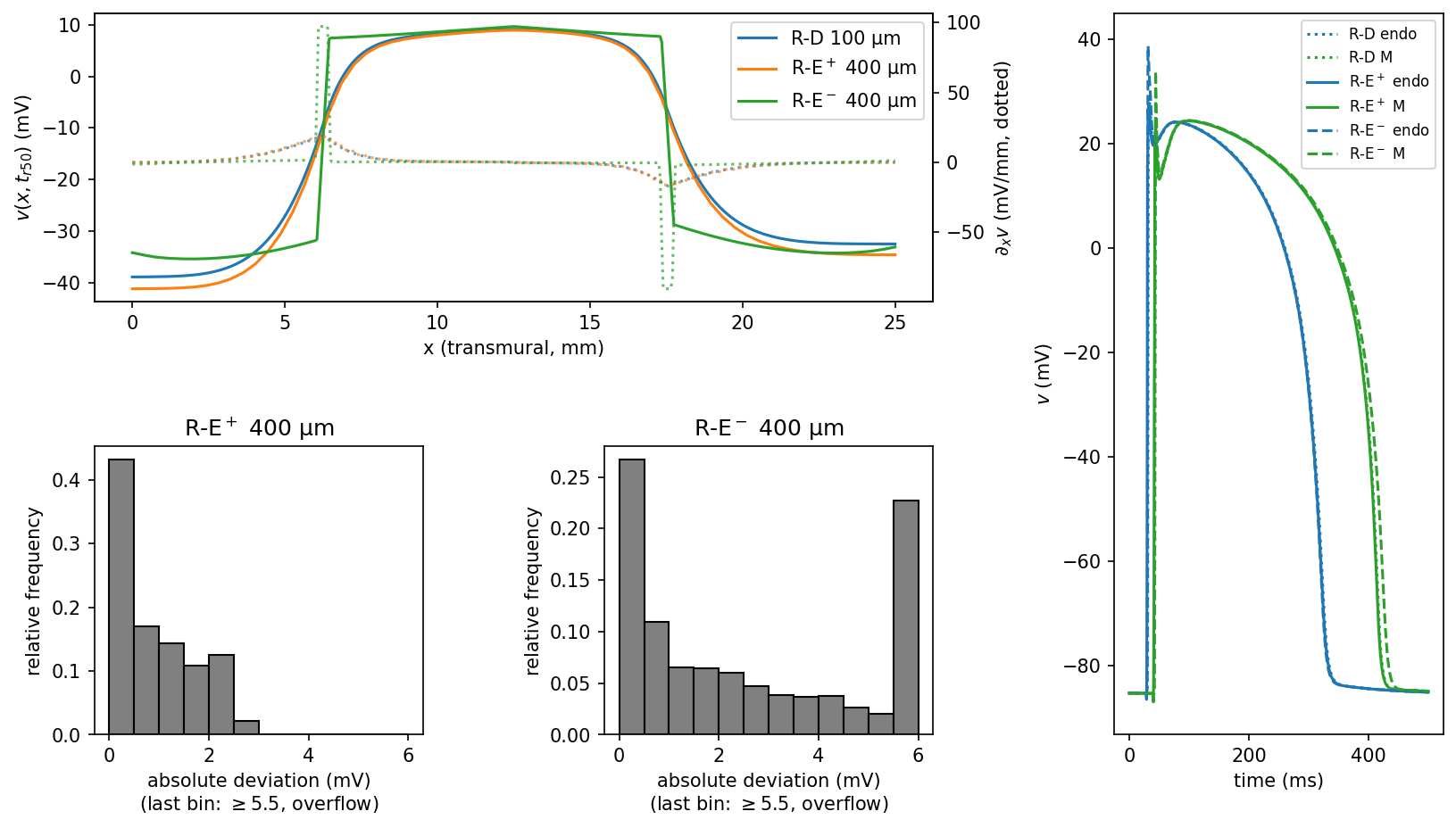
Repolarisation gradients are the sources of the T wave. This demo reproduces Fig. 5 of [NCP+17]: at the instant of 50% repolarisation, \(t_{r50} = 305\) ms, R-E\(^+\) reproduces the transmural profile of \(v\) of the R-D model, while R-E\(^-\), which ignores diffusion, keeps the sharp steps between the epicardial, M and endocardial layers, and so overestimates the gradients. See the activation demo for the models and set-up; as there, all models are bath-loaded (the R-D and R-E\(^+\) models by a conductivity augmented along the surface).
Simulating 500 ms is too long for the documentation build, so we only run R-E\(^-\) — the
cheapest model — on the 400 µm wedge for end_time ms and plot the transmural profile; set
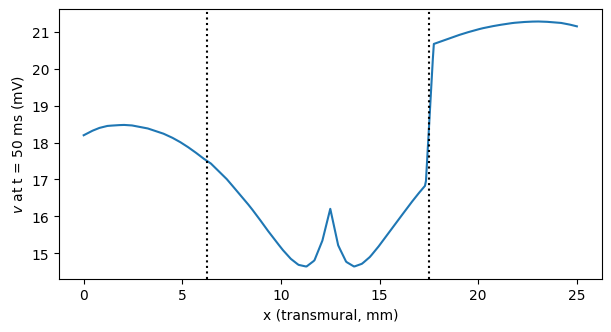
end_time = 305.0 to see the steps at \(t_{r50}\). At the default end_time = 50 ms the cells
are still on the plateau, so the profile is nearly flat with only a small step at the M/endo
boundary; the large layer steps appear at \(t_{r50}\). The precomputed results (100 µm R-D against
400 µm R-E) are shown at the end.
import time as walltime
from pathlib import Path

from mpi4py import MPI

import dolfinx
import gotranx
import matplotlib.pyplot as plt
import numpy as np
import scifem

import beat
from beat.eikonal import Source, solve_eikonal
from beat.reaction_eikonal import ExponentialFoot, FootCurrentODESolver

comm = MPI.COMM_WORLD
dx, dt = 0.4, 0.05  # mm, ms: R-E- has no diffusion, so a larger time step is fine
end_time = 50.0  # ms; 305.0 reproduces t_r50
CV_L, CV_T = 0.594, 0.324  # mm/ms, from scripts/reaction_eikonal_cv.json
wedge = beat.geometry.get_3D_wedge_geometry(comm, dx=dx)
geo = wedge.geometry
V = dolfinx.fem.functionspace(geo.mesh, ("P", 1))
layers = beat.geometry.wedge_layer_markers(V)
ode_dir = Path.cwd().parent / "odes" / "tentusscher_panfilov_2006"
cell_models = {}
for layer, name in {"EPI": "epi", "M": "M", "ENDO": "endo"}.items():
    code = gotranx.cli.gotran2py.get_code(
        gotranx.load_ode(ode_dir / f"tentusscher_panfilov_2006_{name}_cell.ode"),
        scheme=[gotranx.schemes.Scheme.generalized_rush_larsen],
    )
    namespace: dict = {}
    exec(code, namespace)
    cell_models[beat.geometry.WEDGE_LAYERS[layer]] = namespace
init = {k: m["init_state_values"]() for k, m in cell_models.items()}
cells = beat.odesolver.DolfinMultiODESolver(
    v_ode=dolfinx.fem.Function(V),
    v_pde=dolfinx.fem.Function(V),
    markers=layers,
    init_states=init,
    parameters={k: m["init_parameter_values"](stim_amplitude=0.0) for k, m in cell_models.items()},
    fun={k: m["generalized_rush_larsen"] for k, m in cell_models.items()},
    num_states={k: len(v) for k, v in init.items()},
    v_index={k: m["state_index"]("V") for k, m in cell_models.items()},
)
sources = [Source((wedge.cell_tags, tag), t0) for tag, t0 in wedge.stimuli.values()]
t_a = solve_eikonal(geo.mesh, (CV_L, CV_T, CV_T), (geo.f0, geo.s0, geo.n0), sources)
solver = beat.SplittingSolver(pde=None, ode=FootCurrentODESolver(cells, t_a, ExponentialFoot()))
start = walltime.perf_counter()
solver.solve((0.0, end_time), dt)
if comm.rank == 0:
    print(f"R-E-, {end_time:g} ms: {walltime.perf_counter() - start:.0f} s")
2026-11-13 14:22:00 [info ] Load ode /__w/fenicsx-beat/fenicsx-beat/odes/tentusscher_panfilov_2006/tentusscher_panfilov_2006_epi_cell.ode
2026-11-13 14:22:00 [warning ] Dropping a guard whose replacement failed its numeric check value=0 var=Ca_i
2026-11-13 14:22:00 [warning ] Dropping a guard whose replacement failed its numeric check value=0 var=K_i
2026-11-13 14:22:00 [warning ] Dropping a guard whose replacement failed its numeric check value=0 var=Na_i
2026-11-13 14:22:01 [info ] Num states 19
2026-11-13 14:22:01 [info ] Num parameters 53
2026-11-13 14:22:04 [info ] Load ode /__w/fenicsx-beat/fenicsx-beat/odes/tentusscher_panfilov_2006/tentusscher_panfilov_2006_M_cell.ode
2026-11-13 14:22:05 [warning ] Dropping a guard whose replacement failed its numeric check value=0 var=Ca_i
2026-11-13 14:22:05 [warning ] Dropping a guard whose replacement failed its numeric check value=0 var=K_i
2026-11-13 14:22:05 [warning ] Dropping a guard whose replacement failed its numeric check value=0 var=Na_i
2026-11-13 14:22:05 [info ] Num states 19
2026-11-13 14:22:05 [info ] Num parameters 53
2026-11-13 14:22:08 [info ] Load ode /__w/fenicsx-beat/fenicsx-beat/odes/tentusscher_panfilov_2006/tentusscher_panfilov_2006_endo_cell.ode
2026-11-13 14:22:09 [warning ] Dropping a guard whose replacement failed its numeric check value=0 var=Ca_i
2026-11-13 14:22:09 [warning ] Dropping a guard whose replacement failed its numeric check value=0 var=K_i
2026-11-13 14:22:09 [warning ] Dropping a guard whose replacement failed its numeric check value=0 var=Na_i
2026-11-13 14:22:09 [info ] Num states 19
2026-11-13 14:22:09 [info ] Num parameters 53
R-E-, 50 ms: 33 s
The transmural profile along \(y = 12.5\), \(z = 2.5\) mm, with the layer boundaries:
line_x = np.linspace(0, 25, 501)
line = np.column_stack([line_x, np.full_like(line_x, 12.5), np.full_like(line_x, 2.5)])
v_line = scifem.evaluate_function(solver.v, line).ravel()
if comm.rank == 0:
    fig, ax = plt.subplots(figsize=(7, 3.5))
    ax.plot(line_x, v_line)
    for boundary in (6.25, 17.5):
        ax.axvline(boundary, color="k", linestyle=":")
    ax.set_xlabel("x (transmural, mm)")
    ax.set_ylabel(f"$v$ at t = {end_time:g} ms (mV)")
    fig.savefig("reaction_eikonal_wedge_repolarization.png", bbox_inches="tight")
Precomputed results#
Top: \(v\) along the transmural line at \(t_{r50}\) for R-D (100 µm) and the R-E models (400 µm), with the normalised spatial derivative (dotted). Bottom: histograms of the absolute deviation \(|v_{R-D} - v_{R-E}|\) at \(t_{r50}\) over the mid-plane (paper Eq. 34). Right: action potentials at the centres of the endocardial and M layers. As in the paper, R-E\(^+\) matches R-D closely, while R-E\(^-\) has steps at the layer boundaries and larger deviations. Quantitatively, over the mid-plane the absolute deviation from R-D at 100 µm has a median of 0.7 mV for R-E\(^+\) at 400 µm (90% of the points below 2.2 mV, 95% below 2.4 mV) and 2.0 mV for R-E\(^-\) (90% below 11.5 mV, 95% below 16.7 mV, dominated by the layer-boundary steps).